
Building the Future of Education in California
Building and maintaining educational facilities in California has never been straightforward. Public schools operate inside a tangled web of regulations, tight budgets, state proposition funding, and public procurement processes that can move at a pace that would try anyone’s patience. And yet, something has been shifting. A handful of specialized firms have started proving that it is possible to work smarter within that system, moving faster, stretching resources further, and delivering facilities that actually hold up over time.
California is home to more K-12 students than any other state in the country, with over six million pupils enrolled in public schools. Keeping that scale of educational infrastructure in good shape requires contractors and consultants who understand more than just construction. They need to know how school districts actually function: their calendars, their approval chains, their funding streams, and the real pressures that principals and facility directors face every single day.
Against that backdrop, two California companies have built reputations that stand out: The KYA Group, based in Santa Ana, and Zuri Alliance, headquartered in Cameron Park. Both have carved a niche in a market where trust and execution are everything. Their stories, their philosophy, and what their leaders have to say are worth paying attention to.
The KYA Group: more than a construction company
When The KYA Group opened its doors in June 2013, its founders had spotted something nobody else seemed interested in fixing: the public sector, schools in particular, was stuck in outdated ways of doing things that kept slowing down facility upgrades. More than a decade later, the company has grown into one of California’s most recognized specialized contractors, with annual revenues hovering around $150 million and a team of over 190 people.
Operating out of Santa Ana, KYA runs on a model its leadership describes as fundamentally different from a traditional construction outfit. The company is employee-owned, every team member has a stake in the work, and its activity spans three main divisions: KYA Active, focused on sports fields and athletic complexes; KYA Commercial, which handles comprehensive facility modernization; and KYA Create, centered on sustainable landscaping and outdoor environments.
The project portfolio speaks for itself. KYA has renovated the football field at Mt. Diablo High School, delivered a full stadium upgrade at El Capitan High School synthetic turf, all-weather track, bleachers, lighting, and two locker room buildings and completed major work at colleges including Fullerton College, College of the Desert, and Compton College. The company has also expanded beyond California into Texas and Arizona, without ever losing its focus on public education.
One of KYA’s standout products is the CUUBE™ system: a pre-engineered, all-steel construction solution that allows schools and districts to put up gymnasiums, locker rooms, and classrooms with a projected lifespan of up to 100 years and a fast on-site assembly process. For districts that need space urgently and can’t wait years for a traditional build, it has been a genuine alternative.
The company has also been repeatedly named a Top Workplace by USA Today, earning specific recognition for innovation, employee well-being, professional development, and work-life flexibility. In an industry not exactly known for its people-first culture, that kind of recognition reflects something real about how KYA is run.
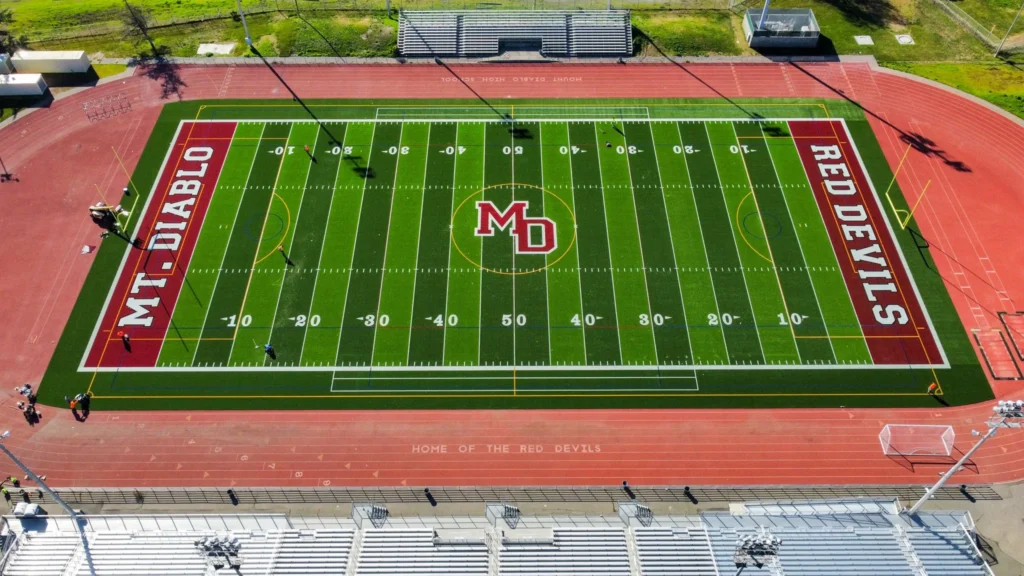
Synthetic Turf Football Field Work Done by KYA @ Mt. Diablo Unified School District
Tony Leyds, CEO of KYA: “We are much more specialized”
Tony Leyds came to the top role at KYA with a background that is unusual in the California construction world. A trained lawyer with a successful legal career in South Africa, Leyds moved to the United States and reinvented himself as an entrepreneur, co-founding USA Shade & Fabric Structures before taking the helm at KYA. That combination of strategic thinking, legal discipline, and entrepreneurial drive has left a clear mark on the company’s culture.
“In some ways, we’re a modern construction company. But we’re much more specialized. Rather than trying to fit square pegs in round holes, we try to find the best solution for the job.”
— Tony Leyds, CEO of The KYA Group
For Leyds, the real value KYA delivers is not just in what it builds, but in how it helps clients get there. The company has invested heavily in what it calls a speed-to-market model, educating districts and public agencies about what procurement tools are actually available to them so projects don’t get bogged down in bureaucratic delays. In the public sector, where a misstep in the purchasing process can set a project back by months, that kind of guidance matters.
“If patience was lacking before COVID, it reached a fever pitch with people expecting results faster than in the past. That’s a positive thing for growth overall, but it also comes with real pressure.”
— Tony Leyds, CEO of The KYA Group
Leyds is open about the fact that the company is always a work in progress. “When we aren’t is the beginning of our demise,” he has said more than once. That willingness to sit with imperfection and keep pushing forward, rather than declare victory and coast, seems to be one of the reasons KYA’s growth curve has shown no sign of flattening after more than a decade.
Zuri Alliance: from hands-on experience to strategic consulting
If KYA was built to construct differently, Zuri Alliance was built so that school districts wouldn’t have to keep suffering through the same problems its founder had watched play out, again and again, over the course of a long career in the field. Travis Barnett, president and founder of the Cameron Park-based firm, has more than 25 years working in public agency facilities management in California. He saw firsthand every bottleneck that slows down school infrastructure projects: the struggle to find reliable contractors, slow bidding processes, wasted budget capacity, and funding opportunities that districts left on the table simply because they didn’t know they existed.
Zuri Alliance works as a facilities consulting firm, specializing in helping K-12 districts, county offices of education, and other public agencies manage their projects more effectively. The pitch is straightforward: bring every client a team of experts who can handle the full lifecycle of a facility, from A to Z, as the name implies,covering everything from strategic planning and financial management to project execution and construction procurement.
The team includes Heather Steer, a facilities and financial consultant with over 25 years inside California school districts, a former Director of Facilities and Chief Business Official, and the holder of certifications including Certified Educational Facilities Planner (CEFP) and Certified Chief Business Official (CBO). Across her career and through her work with Zuri Alliance, she has helped manage over $600 million in public construction projects.
The firm is accredited by the Better Business Bureau and holds an active General Building contractor license (Class B) with California’s Contractors State License Board. Zuri Alliance is also an active presence in sector organizations like the California Coalition for Adequate School Housing (CASH) and the Small School Districts’ Association, showing up regularly at conferences and events across the state.
Travis Barnett, President of Zuri Alliance: “The system works if you know how to navigate it”
Travis Barnett talks about school infrastructure the way someone does when they’ve been on both sides of the equation,as a district employee watching projects grind forward with frustrating slowness, and as a consultant who now helps others avoid repeating those same mistakes. That dual perspective is what makes his approach feel grounded rather than theoretical.
“For years I watched the same problems repeat themselves in district after district — contractors falling short, inflated prices, endless timelines. I knew there was a better way to do it, and I had the tools to show it.”
— Travis Barnett, President of Zuri Alliance
For Barnett, one of the biggest issues in the sector is simply a lack of awareness. California offers school districts multiple pathways to speed up procurement, from the California Multiple Award Schedule (CMAS) to federal GSA contracts but many districts, especially smaller ones, don’t realize these tools exist or assume they’re out of reach. Zuri Alliance steps in as the expert guide who knows the map and can chart the shortest route.
“There are small districts that assume certain funding opportunities or procurement mechanisms just aren’t for them. They’re wrong. The system works if you know how to navigate it — and that’s exactly what we do.”
— Travis Barnett, President of Zuri Alliance
Barnett also emphasizes the human cost of slow execution. Every month a school improvement project is delayed is another month students are stuck in outdated or substandard facilities. For him, moving fast isn’t a business objective, it’s an obligation to the communities being served.
Two companies, one shared mission
The KYA Group and Zuri Alliance represent two complementary approaches to the same underlying problem: how to improve California school facilities more efficiently, more quickly, and with more lasting impact on the communities that depend on them. One does it through direct project delivery, with a portfolio that runs from synthetic turf football fields to century-lasting steel gymnasiums. The other does it through strategic consulting, making sure districts make the right decisions before a single shovel breaks ground.
What both companies share goes beyond methodology. There is a genuine conviction, evident in the way both Leyds and Barnett talk about their work, that schools deserve better facilities, that districts deserve better partners, and that there is a smarter way to operate within the public sector. In a state as complicated as California, that conviction is not a small thing.
As California continues channeling investment into educational infrastructure, driven by Proposition 2 and a steady flow of state and federal funding, companies like KYA and Zuri Alliance are positioned to be central players in that transformation. Not as vendors showing up to bid on jobs, but as partners who understand what’s at stake and have spent years figuring out how to deliver on it.
For more information:
Comments